

Welcome to JewPsy (pr. Jew-sigh), a place for thoughts, discussions, news, and miscellany about all things Jewish and psychological.
Showing posts with label Israel. Show all posts
Showing posts with label Israel. Show all posts
Sunday, July 6, 2014
Han'arim: A Song for Our Lost Boys
Only one week ago, last Friday night after our Shabbat meal, I was putting my son to sleep. He was sad about something—I don't remember what—and I was sad, too, thinking about our missing boys and hoping that they would be found alive. I wrote this song there in his room, to comfort us both, and as a prayer for my son, for the boys, and for all of the Jewish people in anguish and despair. Now that our worst fears have been realized and the missing boys, Naftali Frankel, Eyal Yifrach and Gilad Shaar, are dead, I offer the song with the hope that their holy souls be bound with the souls of the ever-living, and that their families and all of us find comfort in the rebuilding of Jerusalem soon and in our days.


Wednesday, May 18, 2011
Arrest of IMF Head Not So Good for the Jews
"Money, women, and the fact that I am Jewish": three barriers that Dominique Strauss-Kahn mused in a recent interview with the French daily Liberation would stand in his way despite his being the expected favorite for his country's upcoming presidential elections. Turns out one was all it took.
180 Sephardi Girls Shut Out From School
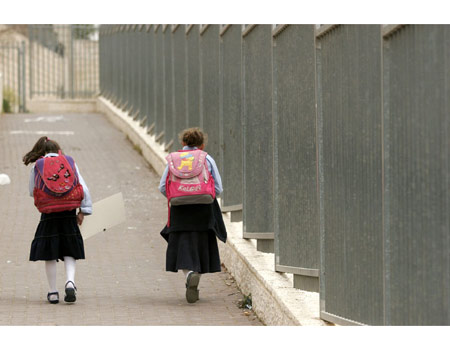
Ynet reports that 180 Sephardi students (students from Middle-Eastern descent) from Jerusalem have no spot in the city's Haredi school system for the 2011-2012 school year after the close of registration. This in addition to the handful of girls who are still without spots from the beginning of this year, and some from 2009. Critics accuse the schools of maintaining an unspoken quota of, at most, 30% Sephardi girls, and accuse the Jerusalem municipality of "washing its hands of the situation year after year, ...deny[ing] the existence of quotas" while doing all it can to support them.
Read the full story here
Published with Blogger-droid v1.6.8
Tuesday, March 8, 2011
The Great Wedding Walkout: Litvish Appeal and the Fight Against Internalized Sephardi Racism

The Rosh Yeshiva walked down the aisle... and right out the door, dragging all of the chosson/chattan's (groom's) friends behind him and leaving the poor newlywed—pleading for him to let the boys stay—to cry alone. At issue: the Israeli rabbi's objection to the bride and groom conducting their wedding according to normative Sephardic halacha. No, this is not an Ashkenazi couple breaking from tradition; both bride and groom are from sephardi families, the groom's father even a rav of a Sephardi congregation. Not even the ruthless Rosh Yeshiva is Ashkenazi; he's a Sephardic man heading a school for Sephardic boys.
Not surprisingly, the Rabbis Yosef, champions of Sephardi halacha, responded quickly and forcefully. Rav Yitzchak Yosef headed straight over to the wedding to celebrate with the abandoned groom and his father, Rav Ovadia invited the groom's family to his Jerusalem home the next day. Rav Avraham Yosef, Chief Rabbi of Holon and Sephardi representative on the Chief Rabbinite Counsel, said in a radio interview that the rosh yeshiva is a "criminal," adding that he should be banished from the city and that it is assur to learn Torah from such a person.
Clearly, the issue here runs deeper than a rabbi being a jerk or supporting the unquestionable halachic basis for following the (legitimate) practices of one's forefathers. This event represents one of the fundamental struggles of Sephardi Jews living as a socio-religious minority group in today's Haredi Israel.
 Tensions between Ashkenazi and Sephardi Jews are nothing new in Israel. Shas and the Education Ministry are still fighting to solve the problem of Sephardi girls sitting at home because they can't find Ashkenazi high schools that will take girls with their skin color. What this fiasco highlights is something more insidious than external Ashkenazi discrimination. It demonstrates Sephardi Jews who have so internalized the societal biases against them that they abandon halacha and human decency in an attempt to "overcome" what the see as their racial handicap.
The most primitive stage is conformity, in which individuals hold negative attitudes and beliefs toward themselves and toward members of the same minority group, while holding appreciating attitudes and beliefs toward members of the dominant group. Individuals at this stage attempt to deny thier own racial/cultural heritage. However, as they encounter information or experiences that are inconsistent with the attitudes, held by the dominant culture they gradually move into the dissonance stage. Here they experience conflict: between thier self-depreciating and self-appreciating attitudes and beliefs, between group-depreciating and group-appreciating attitudes and beliefs toward members of the same minority, and between group-appreciating and group-depreciating attitudes toward members of the dominant group.
As the individual develops through the resistance and immersion stage, he or she comes to completely reject the dominant culture in favor of the beliefs and values of his or hew own race or culture, with increased regard for self and group coming together with group-depricating attitudes toward the majority culture. The introspection stage is where the individual is able to reassess his or her ethno-centric biases after recognizing how draining it is to devote such emotional intensity to and how unsatisfying it could be to hold resistance and immersion-stage views. Finally, by the integrative awareness stage, minority individuals have developed an inner sense of security and they own and appreciate unique aspects of both their own and the mainstream culture.
What Rav Ovadia et. al, are doing is more than just defending their culture. They are fighting to prevent their Sephardic followers from regressing in their cultural identity development to a stage of conformity. In Israel's current socio-religious climate, it is hard to be proud of being a Sephardi. So hard that even a learned man with his own yeshiva, who should know better--both from a halachic and a don't-be-a-jerk perspective--will still go to shameful lengths to try to be like the Ashkenaz. Thier fight is an important one, but time will tell if it can stand up to the force of Litvish appeal.
Saturday, April 17, 2010
Haredim Cancel Protest in Deference to Fallen Soldiers

This is the kind of news report that makes me think (even if only until the siren-blow ends) that there is hope for Klal Yisrael. R' Weiss respected the pleas by parents of deceased soldiers, relayed to him by a letter from Yad Lebanim Chariman Eli Ben Shem, not to hijack the day with their protests. R' Weiss even called Ben Shem personally say that he holds the hospital in high esteem and that he respects the fallen and does not wish to desecrate their memories.
I'm not sure if I would go as far as saying that R' Weiss hold Yom HaZikaron sacred. But I do think this is occasion to hold back cynicism and recognize that this is a significant, if isolated, gesture of good will from one of the most radical poles of Hareidi society. This is even more true in light of the announcement's context: these protests are a hot-button issue that rallies the Hareidi base, and this conciliation was presented as being in recognition of a commemoration that, while sacred to the rest of the country, most Hareidim disparage. This announcement, at the very least, will catch their attention.
 In his letter to R' Weiss, Ben-Shem noted that on Yom HaZikaron, "We all become one united family in front of which stand thousands of families who lost the best of their sons in war while defending the homeland." Who knows? Maybe, this year the radical elements of the Hareidi world will take note of that spirit of achdus and recognize that there might value to finding ways of protecting the Jewish religion that don't have to threaten the unity of the Jewish people.
In the merit of the fallen soldiers' sacrifice, may it be His will.
Thursday, April 8, 2010
Getting Fired Up over the Burqa Ladies
When I was in yeshiva, there was a guy there with darkish skin and a really big beard who used to always get stopped at the airport. Apparently, he bore a striking, but (as far as I know) purely incidental, resemblance to another guy halfway around the world who is even frummer than he is, but in a more... evil sort of way. This story is kind of the same, just a littler weirder. The nod to Islam was a bit more overt, and instead of an innocent yeshiva guy, it involved a follower of a convicted, violent child abuser, dubbed "Taliban mom" by the Israeli media.

I've been following the veil tale for a while now (there's even been a spotting in Brooklyn! Tip of the abaya to Y-Love), but I still can't get my head completely around it. Especially in the current world context. Iran has its sights set squarely on Israel, women there and in the U.S. are fighting for more freedom, and Israeli women chose to restrict themselves even more with Persia's finest?!
Elana Sztokman on Forward's "Sisterhood" blog sees this phenomenon as an extension of the existing rabbinically-imposed stringencies on women's dress, adding that it is difficult for one to "easily distinguish between extreme body cover that is 'normal' and that which is somehow extreme." She continues:
As if women – bombarded with radical messages of body cover supposedly in the name of God that claim the purity of the entire Jewish nation dependent on women’s invisibility – are somehow supposed to be able to know the difference between body cover that is “womanly” and that which is “crazy”. Given the predominance of this rhetoric in the Orthodox community, it was only a matter of time before women internalized the messages to the extreme. What is really infuriating is that none of the male “leaders” in Orthodoxy who rant and rave about women’s body cover now claim responsibility for the current extremism. It’s not their fault. Women have merely taken it “too far.” Right.The problem with Sztokman's argument is that in defending the rights of the oppressively appareled Orthodox, she also sacrifices their intelligence. Besides, the leader of this veiled rebellion, Bruria Keren, does not seem the model of hegemonic submission (just ask her kids!). Nor do her followers who endure well-placed disdain and outcry in the name of their twisted notion of tznius.
No, I think that the burqa bonanza represents a more sophisticated phenomenon that R/M Horowitz and the Women of the Wall know well, but would likely not recognize underneath all those layers: feminism.
In both of those cases, the women and their supporters are interested in the same, fundamentally reasonable thing (even if one's hashkafos don't agree with their specific arguments): finding a meaningful place for women in contemporary Jewish life. I believe the Burqa Brigade is motivated by the same drive. The only difference between the maharats and the muftis, between the rabbas and the burqas is the culture from which they emerged.
In the relatively open Modern Orthodox society, dissent is tolerated, and even civilly engaged. The goals of the dissenting women reflect both the religious and social ideals of their community: scholarship, personal achievement, and spiritual self-actualization. The flexibility of Modern Orthodoxy’s religious boundaries also means that dissenters can envision their goals at just the borders of the movement, stretching just enough while remaining, they hope, within the fold.
The female dissenters that Haredi Israel produces reflect equally upon that society's socio-religious makeup. There, where overt challenges to religious-political norms are not tolerated, dissent must be more subtle (even if the behavior is not). Where women have no voice, their protest must be without words. There, frumkeit is king (now queen), and individuality a nobody. In the monolith that is Haredi-brand Judaism, boundaries are binary, and there is no stretching; fighting at the margins only guarantees marginalization. Women who grasp at power in that world cannot stage their battle at the periphery, they must fight at its core.
The Haredi women who wear the burqa are not looking to be more eidel than your maidel; they're fighting the power. They keenly recognize that purloining power in their communities means reclaiming the reins of religiosity. So they’re really stickin’ it to the man by being frum in the only way he says they can’t. These women are reclaiming sexual repression and hegemony, holding halacha over their own heads as if to say "I'm the boss of me!" as much as "Grab it if you can!"
Think of it this way... if Lipa is the Haredi Kanye West, and Yidden is the Haredi Stayin' Alive, then donning the Burqa is the Haredi bra burning!

Tuesday, March 23, 2010
All Learning, No Play: Calls to Restrain Bochurim on Break

Israeli roshei yeshiva this year are are taking literally the Torah's charge of "shmor es chodesh ha'aviv" (literally, "Protect the spring month"). "Dei'ah Vedibur" (a website that bills itself as "a window into the Chareidi world") reports that these educators are urging parents to safeguard their children from the myriad spiritual dangers of bein hazmanim (lit. "between terms," in this case referring to the Pesach break that for many yeshivos spans the full month of Nisan). Those dangers include the usual suspects—Haredi internet sites and unblocked cellphones—but also include unsupervised trips to the North of Israel.
The roshei yeshiva's stance apparently follows a notice distributed in the name of two preeminent gedolim from Yerushalayim and Bnei Brak, HaRav Yosef Sholom Eliashiv and HaRav Aharon Leib Shteinman. The notice, signed by those rabbis, is entitled "Amoleinu: Eilu HaBonim," a quote from the Haggadah (and Midrash) referring the the ancient Egyptians' practice of drowning newborn Jewish boys. This type of notice is a common medium for influencing public opinion in the Israeli Haredi community, which has traditionally shunned other forms of media. However, while the roshei yeshiva are treating the present announcement as genuinely from those gedolim, it is often difficult to verify the authenticity of the signatures on such notices.
Regarding trips, the notice exhorts:
Parents must be alert to the dangers and exhibit foresight and stand guard, not allowing their sons to set out on trips. If there is a real necessity they should take part in organized trips with proper supervision to prevent spiritual and physical dangers.
This position is nothing new. Haredi and Chassidish yeshivos and communities—both in Israel and the United States—have steadily stripped away boys' opportunities for exercise, play and other non-learning outlets, leaving them with scarce opportunities for stress relief or relaxation. This leaves boys, especially older ones, out of shape, overwhelmed by the demands of a long yeshiva day, and, in many cases, looking for alternative releases. In fact, even the learning itself suffers when students don't have enough recess and exercise. This announcement only tightens those restrictions, extending them to bein hazmanim, and even to trips that are not "real necessit[ies]."
Maybe one day the roshei yeshiva will recognize the need to address the whole student, with all of his or her needs and development. Until then, however, Israeli yeshiva bochurim will have to rethink the meaning of "Zman Cheiruseinu."
Subscribe to:
Posts (Atom)