Showing posts with label education. Show all posts

Monday, September 9, 2013

Teachers: Save the First-Day Freshness

Teacher holds boy's hand on first day of school
Happy first day of school!

There's something special about the first day of school, for students and for teachers, that's hard to replicate at any other time in the school year. Sure, it's a little hectic and a tad stressful, but that's all overshadowed by the wonderful freshness of the day. We're excited to see the kids and to have them enjoy the rooms we worked so hard on, and we're eager to throw ourselves into reaching our curricular and personal goals.

Wednesday, May 18, 2011

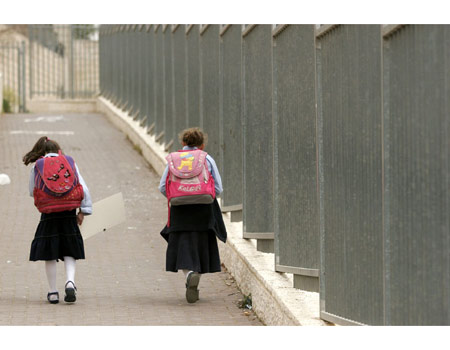
180 Sephardi Girls Shut Out From School

Old biases die hard; we Jews know that. But for Sephardi Jews in Israel's "ultra-Orthodox" Haredi community, discrimination and exclusion--by their fellow Jews--serve as regular reminders.

Ynet reports that 180 Sephardi students (students from Middle-Eastern descent) from Jerusalem have no spot in the city's Haredi school system for the 2011-2012 school year after the close of registration. This in addition to the handful of girls who are still without spots from the beginning of this year, and some from 2009. Critics accuse the schools of maintaining an unspoken quota of, at most, 30% Sephardi girls, and accuse the Jerusalem municipality of "washing its hands of the situation year after year, ...deny[ing] the existence of quotas" while doing all it can to support them.

Read the full story here
JewBrain Tinier
Published with Blogger-droid v1.6.8

Monday, April 26, 2010

When to Turn Away Students from Orthodox Schools

Emes Ve'emunah


What should the parameters be for accepting a child into a religious school? 


What if a parent pulls a child out of an Orthodox day school sends that child to a Conservative day school to finish elementary school and then applies to an Orthodox high school? Should the school accept the child? I have been told by an acquaintance that this happened to a parent. The parent was told that there were other reasons for denying but she denies that there were. She ended up sending her child to a public school. 


There are several issues here. Is public school a better alternative than sending a child to a religious elementary school where heretical ideas are accepted? On the one hand I would think such a school is forbidden. On the other hand, I would think that in the lower grades where there is no discussion about those ideas and only the basics are taught, it might be better than a public school where there is hardly a trace of Judaism with the possible exception of Chanukah as a co- holiday with Christmas.


One thing is certain. If a child attends a Solomon Schechter elementary school and then an Orthodox high school, there is a far greater chance of successfully integrating into the religious community – since the basics will have been learned. On the other hand it is possible that the seeds of a heretical idea may have somehow been planted into a child’s mind and that can warp essential Jewish belief in the future – and possibly expose others to those thoughts.(Continued...)
JewBrain Tinier

Tuesday, March 23, 2010

All Learning, No Play: Calls to Restrain Bochurim on Break


Israeli roshei yeshiva this year are are taking literally the Torah's charge of "shmor es chodesh ha'aviv" (literally, "Protect the spring month"). 
"Dei'ah Vedibur" (a website that bills itself as "a window into the Chareidi world") reports that these educators are urging parents to safeguard their children from the myriad spiritual dangers of bein hazmanim (lit. "between terms," in this case referring to the Pesach break that for many yeshivos spans the full month of Nisan). Those dangers include the usual suspects—Haredi internet sites and unblocked cellphones—but also include unsupervised trips to the North of Israel. 


The roshei yeshiva's stance apparently follows a notice distributed in the name of two preeminent gedolim from Yerushalayim and Bnei Brak, HaRav Yosef Sholom Eliashiv and HaRav Aharon Leib Shteinman. The notice, signed by those rabbis, is entitled "Amoleinu: Eilu HaBonim," a quote from the Haggadah (and Midrash) referring the the ancient Egyptians' practice of drowning newborn Jewish boys. This type of notice is a common medium for influencing public opinion in the Israeli Haredi community, which has traditionally shunned other forms of media. However, while the roshei yeshiva are treating the present announcement as genuinely from those gedolim, it is often difficult to verify the authenticity of the signatures on such notices.


Regarding trips, the notice exhorts:
Parents must be alert to the dangers and exhibit foresight and stand guard, not allowing their sons to set out on trips. If there is a real necessity they should take part in organized trips with proper supervision to prevent spiritual and physical dangers.


This position is nothing new. Haredi and Chassidish yeshivos and communities—both in Israel and the United States—have steadily stripped away boys' opportunities for exercise, play and other non-learning outlets, leaving them with scarce opportunities for stress relief or relaxation. This leaves boys, especially older ones, out of shape, overwhelmed by the demands of a long yeshiva day, and, in many cases, looking for alternative releases. In fact, even the learning itself suffers when students don't have enough recess and exercise. This announcement only tightens those restrictions, extending them to bein hazmanim, and even to trips that are not "real necessit[ies]." 


Maybe one day the roshei yeshiva will recognize the need to address the whole student, with all of his or her needs and development. Until then, however, Israeli yeshiva bochurim will have to rethink the meaning of "Zman Cheiruseinu."
JewBrain Tinier

Thursday, March 11, 2010

A Plea for Moderation in Yiddishkeit

Fine essay by Rabbi Yaakov Horowitz, originally published in the Jewish Press, responding to the now-famous computer stomping video. 
The radical views like those espoused by [the computer-smashing Rosh Yeshiva] and illustrated by his actions are stomping on far more than a single laptop. Such views threaten to trample the future - and Yiddishkeit - of the families who follow them.
Extremism might turn out a few kanna'im, but it will turn off many more kids and adolescents.
JewBrain Tinier


Sunday, January 17, 2010

There Will Be Blood: Corporal Punishment in Yeshivos and Chadorim

We have a lot to be proud of. The advocates, professionals, and other caring souls in and around the Chareidi communities have managed to keep the talk of sexual abuse going long enough that the painfully slow wheels of change might finally be starting to turn. And yet, that vice has an advantage over the other pieces of our collective dirty laundry: the disgusting factor. People can pretend that sexual abuse does not exist in our communities, or that if it does we shouldn't talk about it. But no one in their right mind would actually justify it. No one would say that molesting a child serves some higher purpose, or any purpose at all for that matter, other than the selfish perversions of the perpetrator.  

That is not the case, however, for the other abuse that our children continue to face. To this day yeshivos and chadorim (religious boys' schools) routinely employ corporal punishment as regular, first-line means of discipline, leaving scores of helpless children traumatized and turned off to the very Yiddishkeit (Judaism) that the rebbeim (rabbis) and menahalim (administrators) are so pathetically trying to beat into them. These "educators" make no excuses about their "hands-on" methods: "This is just the way that we teach our boys." It is the only system they know: the one to which they were subjected when they were helpless children themselves. They blindly regurgitate the same simplistic readings of rabbinic sources that their own abusers relied on and the shailos (rabbinic opinions) that they have asked to help allay their guilt. All the while, the very real trauma that they inflict on their charges is somehow ignored.

The scars of sexual abuse run as deep as any. However, even when children are molested in a school, they are the exceptions, certainly not the rule. (As an aside, the majority of sexual abusers are not teachers, but family members or "friends.") The most egregious part of rebbeim's beating up on their students is that the abuse is institutionalized, the maltreatment systemic and universally divvied. This is an offense perpetrated by the community as a whole: institutions, leaders, parents, and culture alike. 


That has several important ramifications. Obviously, that means the wealth is spread nice and widely; no child in a "beating cheider" is immune from the blows. It also means that there are likely to be few sympathetic adults to support traumatized victims. Like the rebbe who'll smack you a second time for crying, school personnel in these offending institutions are more likely to retraumatize the victims and deepen the wounds than they are to have anything sympathetic, let alone therapeutic, to say. Finally, it means that rooting out this vice will take much more than exposure. It will require a fundamental shift in the pedagogical culture. For starters, elementary school teaching positions will have to be filled by more than simply "those who can't." Rebbeim will need to begin to meet certain basic qualifications, such as (a) liking children, (b) wanting to teach, (c) being (somewhat) able to control a classroom, and (d) being (somewhat) able to control oneself. "The way we've always done it" will no longer suffice as justification for blindly continuing practices that ruin human beings' lives without being at all effective.


Rebbeim and menahalim would do well to listen to their talmidim's (students') perspective on all this. For, despite their cynical assumptions, these kids are far from stupid, and they see perfectly clearly what this is all about. As one 11-year-old client told me recently, "even when they hit us, unless it's really hard, we don't cry. We just laugh. We all know that the rebbi's just hitting 'cause he has no control at all. He just gets so angry, and he doesn't know what else to do. It's so pathetic it's kind of funny."


So for now, I submit, until we can change this pitiful practice, there are two things we caring souls can do with the battered boys of our community: laugh and cry. For the terrorized boy who swallows his tears, afraid to lower his head lest he attract another smack, we can cry with him. And for the boys who laugh at the poor rebbi whose dignity was lost along with his self-control, we most certainly can laugh with him, too.


-PsyJew JewBrain Tinier